

Media Literacy and Digital Citizenship for Teachers
Media Literacy and Digital Citizenship for Teachers
Media Literacy and Digital Citizenship for Teachers
Help students navigate the digital world with confidence, curiosity and responsibility. This practical Erasmus+ teacher-training course introduces accessible strategies for recognising misinformation, checking online sources, understanding social media and promoting respectful digital behaviour. Through interactive workshops, real-world examples and collaborative classroom activities, teachers explore how to strengthen critical thinking and digital citizenship across different subjects and age groups. Participants leave with ready-to-use media literacy lessons, a fact-checking toolkit and practical resources for safer, more responsible online participation.
Understanding Media Literacy in Everyday Teaching
Students encounter information through social networks, video platforms, messaging applications, websites and digital learning environments. They need practical skills to distinguish reliable information from misleading content, understand how online messages influence opinions and make thoughtful decisions when sharing information.
This five-day Erasmus+ teacher-training course helps educators develop these skills through accessible, hands-on workshops. No advanced technical knowledge is required.
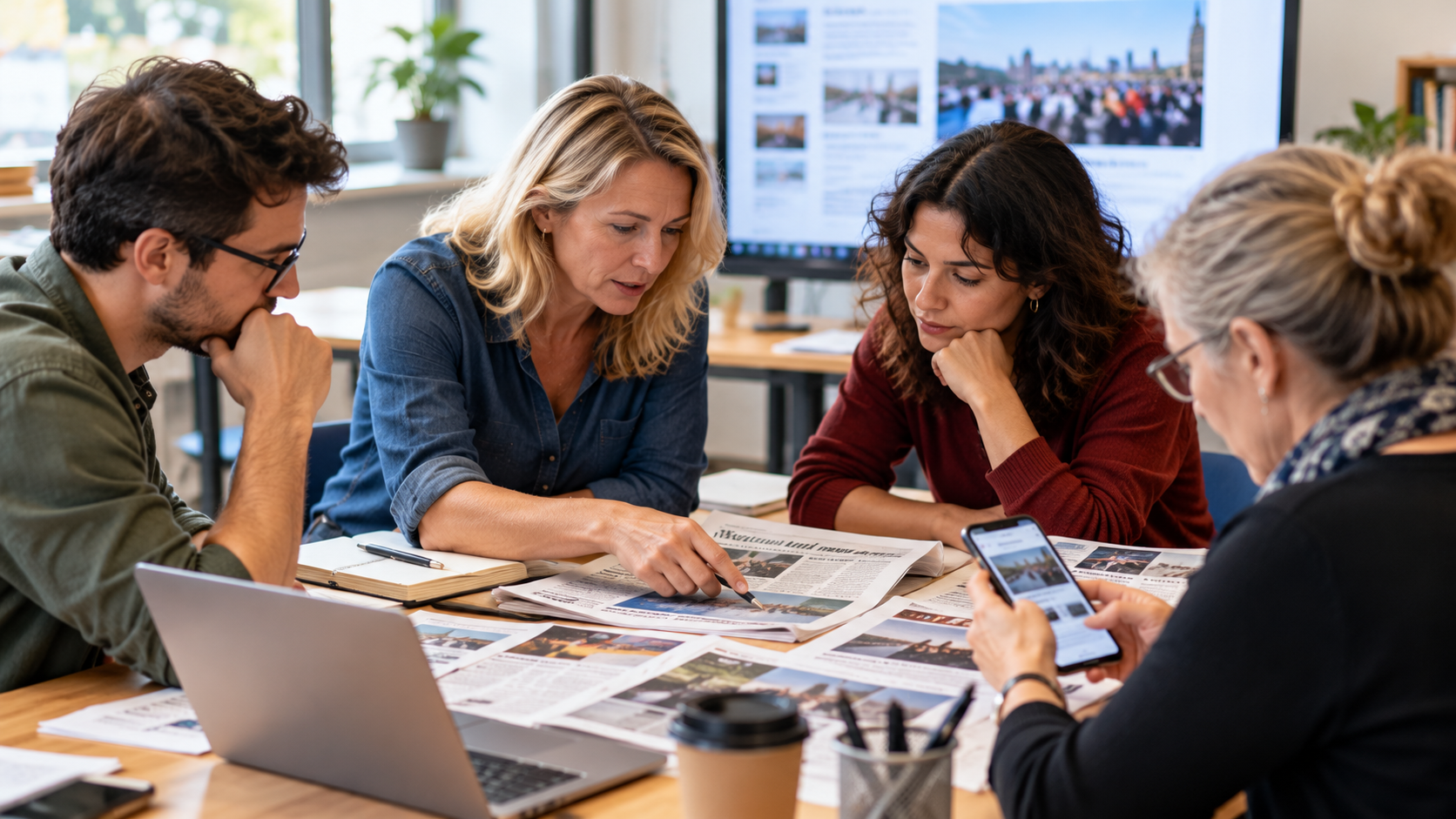
Participants explore how media literacy connects with subjects such as languages, history, science, citizenship and social studies. For example, a science teacher might ask students to verify a viral environmental claim, while a language teacher could compare the wording of headlines reporting the same event.
The emphasis is on simple activities that teachers can realistically introduce into existing lessons.
Spotting Misinformation and Checking Facts
One of the main workshop themes is recognising misleading information.
Participants examine examples of sensational headlines, edited images, misleading statistics, false claims and information presented without context. They learn to distinguish misinformation from intentionally deceptive disinformation without assuming they can determine a publisher’s intentions from a single post.
Teachers practise a straightforward fact-checking routine: pause before sharing, investigate the source, compare independent evidence and trace a claim to its original context.
A practical exercise asks participants to investigate three online claims and document the evidence supporting or challenging each one.
Teachers also explore reverse image searching and discuss why a genuine photograph can become misleading when reused with an inaccurate caption.
The resulting fact-checking worksheet can be adapted for different age groups.
Understanding Social Media and Digital Influence
Social media platforms shape how information is discovered, presented and shared.
Participants investigate recommendation systems, personalised feeds, influencer content, sponsored posts and engagement-driven headlines.
In a classroom simulation, groups receive different selections of information about the same topic. They compare how those selections might influence perceptions and discuss why online users do not necessarily encounter identical information.
Teachers then develop questions students can use when evaluating online messages: Who created this? What is the purpose? What evidence is available? What might be missing?
The workshop also introduces responsible discussion of AI-generated images and manipulated media. Participants learn not to rely solely on appearance when deciding whether digital content is authentic.
Promoting Responsible Digital Citizenship
Media literacy is closely connected to everyday online behaviour.
Teachers explore digital footprints, privacy settings, responsible sharing, online communication, copyright and respectful participation in digital communities.
Practical scenarios include forwarding an unverified message, publishing a class photograph, sharing another person’s content without permission and responding to an offensive online comment.
Participants practise guiding students towards safer choices without using fear-based messages or assuming that all online participation is harmful.
A digital citizenship agreement is developed around respect, verification, consent, privacy and responsible communication.
Making Media Literacy Accessible
The course considers how to involve students with different reading abilities, language backgrounds and levels of digital access.
Teachers practise simplifying instructions while retaining the intended critical-thinking challenge. Activities may include short visual examples, paired source comparisons, guided discussion cards and paper-based fact-checking tasks.
For multilingual learners, participants create vocabulary supports for terms such as source, evidence, opinion, claim and verification.
Where classroom internet access is limited, teachers learn to prepare printed screenshots and offline source-comparison activities.
Participants also consider how to discuss sensitive or controversial content respectfully, avoiding unnecessary exposure to harmful material.
Creating Practical Classroom Resources
The final workshops focus on turning knowledge into ready-to-teach activities.
Teachers work individually or in small groups to create a 45-minute media literacy lesson. A typical lesson might ask students to compare two headlines, investigate a claim, explain their findings and complete a short reflection.
Participants also prepare a student fact-checking worksheet, an online behaviour agreement and a short knowledge-check activity.
Peer feedback focuses on clarity, age appropriateness, accessibility and classroom feasibility.
Concrete workshop output — Digital Citizenship Toolkit: Each participant develops a collection containing a 45-minute lesson plan, source evaluation checklist, four-step fact-checking worksheet, digital citizenship agreement and student reflection or assessment task.
The course aims to make media literacy an achievable part of everyday teaching, rather than an additional specialist subject.
- Strengthen teachers’ understanding of contemporary media and digital information.
- Develop practical skills for recognising misinformation and verifying online claims.
- Improve teachers’ ability to evaluate digital sources and visual content.
- Explore the influence of social media platforms and online advertising.
- Promote privacy awareness, respectful communication and responsible sharing.
- Integrate critical thinking and digital citizenship into different school subjects.
- Support accessible, age-appropriate and low-tech media literacy activities.
- Enable participants to create classroom-ready media literacy resources.
By the end of the course, participants will be able to:
- Distinguish between factual reporting, opinion, advertising, satire and misleading content using authentic or simulated examples.
- Apply a four-step fact-checking process to verify at least three online claims.
- Evaluate website and social media sources using criteria such as authorship, evidence, purpose and publication context.
- Demonstrate reverse image searching and basic image-context verification using appropriate tools.
- Explain how social media algorithms, personalised feeds and online advertising can influence the information people encounter.
- Design an age-appropriate classroom activity addressing digital footprints, privacy or respectful online communication.
- Create a media literacy lesson with accessible instructions, collaborative tasks and an observable assessment activity.
- Produce a classroom-ready Digital Citizenship Toolkit containing fact-checking resources, student activities and online behaviour guidance.
Day 01
Media Literacy Foundations
- Introductions and exploration of teachers’ digital media challenges.
- Workshop: distinguishing news, opinion, advertising and misleading content.
- Comparing headlines and identifying persuasive language.
- Designing a short media-awareness starter activity for students.
Daily output: Media literacy starter activity.
Day 02
Fact-Checking and Source Verification
- Investigating misleading claims and identifying missing evidence.
- Practising lateral reading and cross-checking independent sources.
- Reverse image search and image-context verification workshop.
- Creating a student-friendly source evaluation checklist.
Daily output: Four-step fact-checking worksheet and verification checklist.
Day 03
Social Media and Online Influence
- Exploring personalised feeds, recommendation systems and online advertising.
- Group simulation of how different information feeds shape perceptions.
- Analysing influencer messages, sponsored content and manipulated media.
- Designing classroom discussion cards about digital influence.
Daily output: Social media analysis and discussion activity.
Day 04
Digital Citizenship and Responsible Participation
- Digital footprints, privacy and consent scenario workshop.
- Role-playing respectful responses to challenging online interactions.
- Exploring copyright, attribution and responsible content sharing.
- Creating a classroom digital citizenship agreement.
Daily output: Digital citizenship agreement and student scenario cards.
Day 05
Classroom Application and Toolkit Development
- Designing a 45-minute media literacy or digital citizenship lesson.
- Adapting resources for different ages, languages and digital access levels.
- Microteaching selected activities with structured peer feedback.
- Assembling and presenting the completed Digital Citizenship Toolkit.
Final output: Classroom-ready Digital Citizenship Toolkit.
Past participants say...
The fact-checking activities were simple to understand and easy to adapt for my students. I especially liked the practical approach to evaluating online sources.
Isabel GarcíaSpain
The social media exercises helped me think about how students encounter information online. The classroom discussion materials were particularly useful.
Marta NowakPoland
I appreciated that the activities did not require advanced technical knowledge. The digital citizenship agreement is a practical resource that I could adapt for my classroom.
André SilvaPortugal
SEVERAL UNIQUE COURSES
Other Courses You May Like

- Antalya, Dublin, Düsseldorf, Istanbul
- One-Week course

- Antalya, Cologne, Dublin, Düsseldorf, Frankfurt, Istanbul
- One-Week course
- Antalya, Düsseldorf, Istanbul
- One-Week course

- Antalya, Cologne, Düsseldorf, Istanbul
- One-Week course

- Antalya, Cologne, Düsseldorf, Istanbul
- One-Week course
Previous
Next
-
Certificate
Yes -
Cost
€80/day -
Language
English -
Duration
One-Week course
prereg button test
All Available Dates
= confirmed date
No dates available, kindly contact us for more details
No dates available, kindly contact us for more details
No dates available, kindly contact us for more details
No dates available, kindly contact us for more details
No dates available, kindly contact us for more details
How Can We Help?
If you require any further details or if you have question? Please don’t hesitate to contact us.
- info@phxtraining.com
OID: E10339609
More Erasmus Training Courses